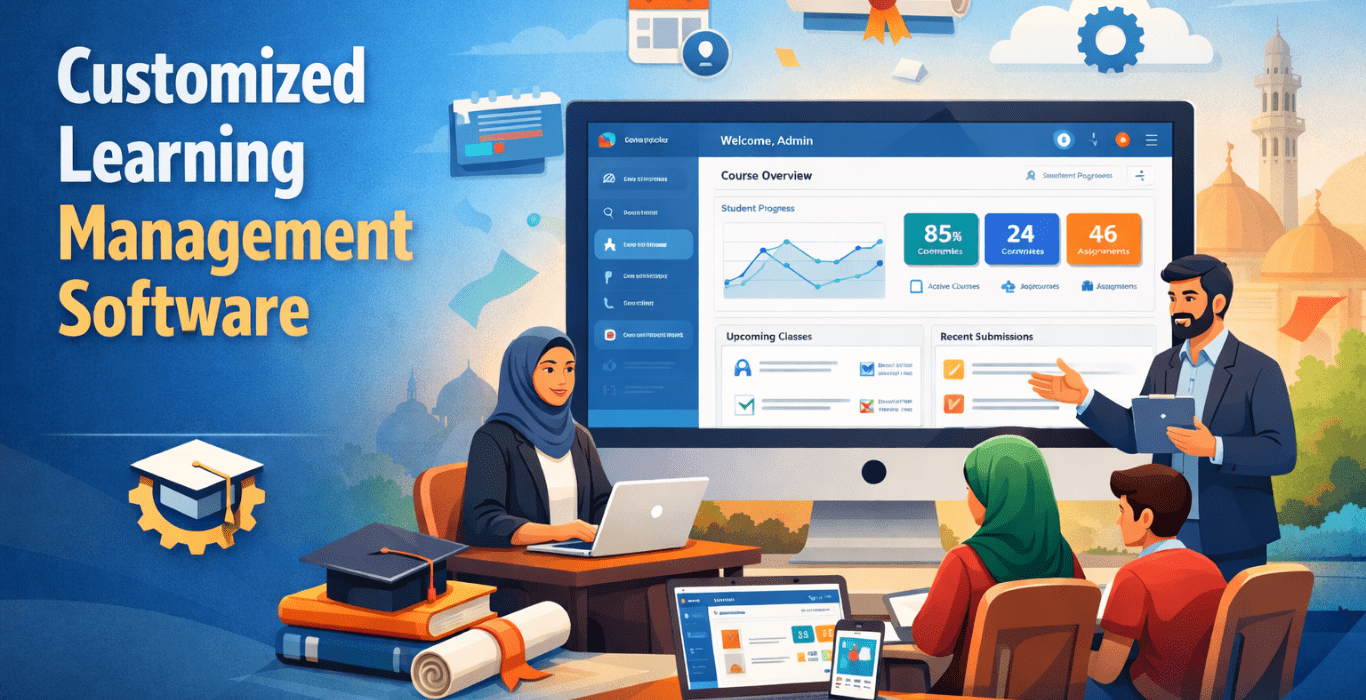
Customized Learning Management Software in Karachi Pakistan
INTRODUCTION:
In today’s world, Digital Learning is an integral part of the education system. Educational institutes, schools, colleges, and universities are increasingly using technology and learning management systems for better management of courses, student engagement, and academic operations. However, many educational institutes face difficulties with generic learning management systems that do not match their academic and administrative systems. This is where Customized Learning Management Software can be of immense help.
Customized Learning Management Software helps educational institutes create a digital learning environment that matches their academic and administrative systems. Instead of changing their academic and administrative systems according to the learning management system, educational institutes can create a system that matches their academic system. For educational institutes in Pakistan, using Customized Learning Management Software can be very beneficial for them.
Industry Challenges in Educational Technology
Institutions may initially use standard LMS solutions, expecting them to help overcome digital learning challenges. However, these solutions may also come with certain limitations, leading to operational challenges.
Limited Flexibility
The standard LMS solutions may be based on a fixed architecture. This may cause operational challenges for academic institutions with unique academic structures.
Integration Challenges
Academic institutions may be using a variety of solutions, including student information management systems, online admission systems, and digital attendance management systems. This may cause integration challenges with standard LMS solutions.
Scalability Challenges
Academic institutions may be expanding, and thus, the digital solutions may also have to be scalable. This may cause operational challenges with standard LMS solutions.
Lack of Adaptation
The academic structures in Pakistan may be different from global academic structures. This may cause operational challenges in adapting standard LMS solutions with academic structures.
How Customized LMS Solutions Solve These Challenges
Customized Learning Management Software solutions help address these problems in an effective manner.
Instead of using a generalized platform, educational institutions can use a customized LMS solution that meets the operational needs of the institution.
Customized solutions help educational institutions have better control over the digital environment of their students.
Customized solutions enable the integration of various platforms used in educational institutions, including:
- Student management systems
- Admission systems
- Examination systems
- Faculty management systems
By integrating these systems with a single platform, educational institutions can develop a single digital environment.
In most cases, educational institutions use platforms like Smart Campuses, which offer customized solutions in the field of educational technology.
KEY FEATURES OF CUSTOMIZED LEARNING MANAGEMENT SOFTWARE
A well-designed Customized Learning Management Software has many advantages for educational institutions.
Flexible Course Management
Educational institutions can manage courses according to their own requirements. Departments can manage modules, lectures, and assignments according to their own framework.
Personalized Learning Experience
Students can experience a learning environment that is customized to meet their needs. This may include interactive learning content, digital assessments, and much more.
Seamless System Integration
The Customized Learning Management Software is integrated with existing student information systems, ERP systems, and administrative systems to ensure efficient running of institutions.
Advanced Analytics and Reporting
Administrators and faculty can access detailed reports on student activities, courses, and learning to improve student outcomes.
Scalability for Growing Institutions
The Customized Learning Management Software is built to cater to institutions that are expanding in terms of student numbers and departments.
Improved Faculty Collaboration
Faculty members can collaborate with each other through digital resources available on the LMS platform.
Implementation in Educational Institutions
The implementation of Customized Learning Management Software involves a strategic approach.
- Step 1: Identify Institutional Requirements
The educational institutions need to identify their academic processes, courses, and institutional processes. - Step 2: Select the Right LMS Development Partner
The selection of the right EdTech partner is of significant importance for the successful implementation of LMS, as it will be developed with the aim of fulfilling the goals and requirements of the educational institutions. - Step 3: System Integration
The LMS will be integrated with existing digital systems. - Step 4: Training and Onboarding
The training of the faculty and administrative staff is necessary for the successful implementation of LMS. - Step 5: Continuous Improvement
The educational institutions need to continuously monitor the usage of LMS for better digital learning strategies.
CONCLUSION:
The move towards digital education has led to the incorporation of Learning Management Systems as a key component of the academic system. However, Learning Management Systems are not able to meet the operational requirements of educational institutions.
By implementing Customized Learning Management Software, educational institutions such as schools, colleges, and universities are able to develop a digital education system that matches their academic system perfectly.
For educational institutions looking to enhance the digital education system and operational efficiency of the system, investing in Customized Learning Management Software is a key move towards academic innovation.