
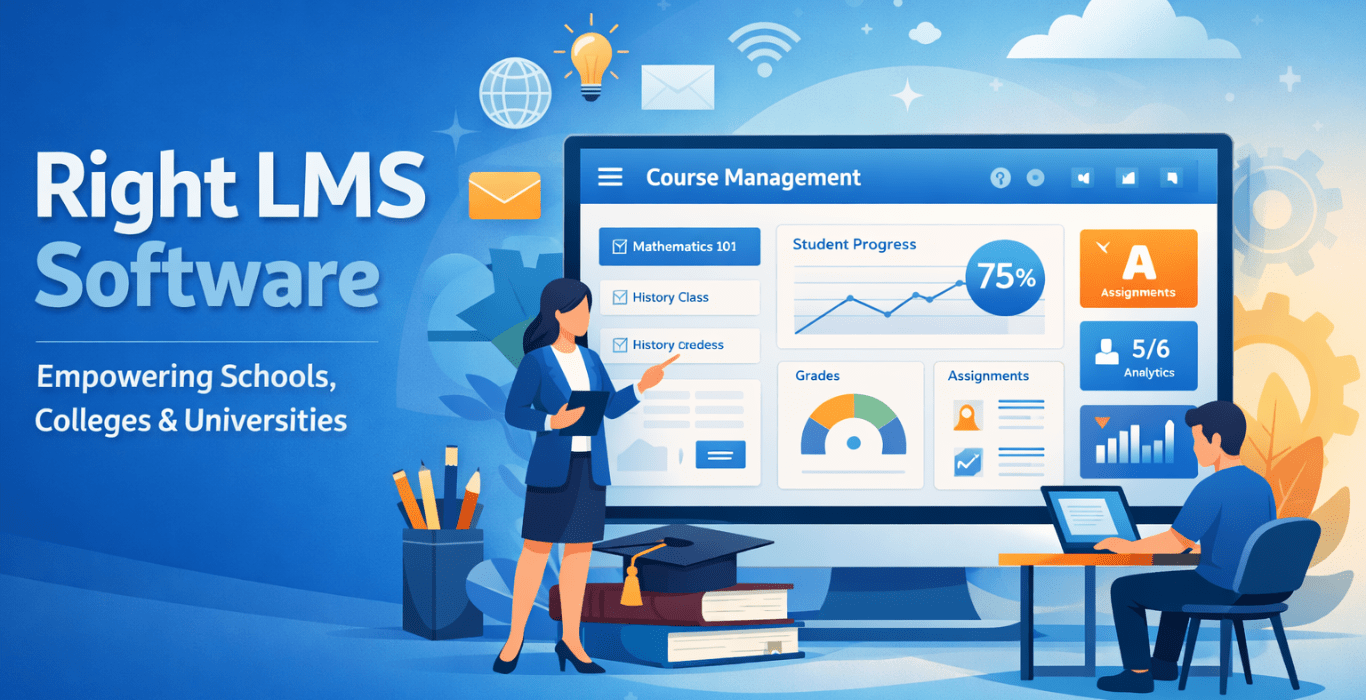
How to Choose the Right LMS Software for Institutions
Click to Start Whatsapp Chat with Sales
Call #:+92 3332233287
Email:Info@smartcampuses.com
INTRODUCTION:
Educational institutions across the world are changing at a rapid pace. Schools, colleges, and universities are now relying on technology to automate their processes. Thus, it is imperative that school owners, college directors, university administrators, and managers across Pakistan consider the importance of learning management system software in their institutions.
A learning management system is an effective tool that enables institutions to automate their courses, monitor student performance, offer online learning, and automate various processes. However, it is not easy to choose the right learning management system software in the market.
For school owners, college directors, university administrators, managers, and managers across Pakistan, it is imperative to understand what makes the Right LMS Software effective in their institutions.
Challenges in Selecting LMS Software in the Industry
There are various challenges that an educational institution faces in selecting an LMS software solution. This is because most institutions focus on the basic functions of the software rather than the overall needs of the institution.
SOME OF THE CHALLENGES INCLUDE:
Limited Digital Infrastructure
In most cases, institutions implement an LMS software solution without examining its technical suitability in relation to other existing systems, such as student information systems or ERP systems.
Poor User Adoption
In most cases, the adoption rate of the LMS software is low among the teaching staff. This is because the software interface is too complicated.
Inefficient Academic Management
Without the Right LMS Software, an institution faces many challenges in terms of managing various activities within the institution.
How Modern LMS Solutions Address These Problems
Modern learning management systems help in making digital education and academic administration easy. With the Right LMS Software, it is easy to integrate various academic activities into an integrated system. This makes it easy to administer various activities in an academic institution.
A modern learning management system usually has various features that include course management, assessment, communication between students and teachers, and real-time analytics. This makes it easy to monitor performance, improve teaching strategies, and ensure proper record-keeping.
In addition, modern learning management systems like the Right LMS Software are cloud-based. This makes it easy to access the system anywhere. This is important in modern learning environments that include remote learning.
Therefore, if properly utilized, the Right LMS Software is capable of transforming the way various learning institutions administer knowledge, performance, and student engagement.
KEY FEATURES OF THE RIGHT LMS SOFTWARE
In evaluating an LMS software, it is imperative that the institution considers various key features that enable it to effectively manage both learning and academics.
Course Management
This feature enables administrators and teachers to create, organize, and distribute course materials in an organized manner.
Online Assessments and Grading
This feature enables quizzes, assignments, grading, and performance tracking among students.
Student Progress Tracking
This feature enables real-time analytics that help in tracking student engagement and performance.
Communication Tools
This feature enables communication between teachers and students, thus fostering collaboration.
Mobile Accessibility
This feature ensures that both students and teachers can access learning materials anywhere, at any time, using their mobile devices.
Integration Capabilities
The Right LMS Software is capable of integrating with ERP software, student databases, as well as other third-party education software.
Security and Data Protection
This feature ensures that sensitive student and institution data is protected by using robust authentication methods and encryption.
Practical Implementation in Educational Institutions
Implementing an LMS requires proper planning and institutional alignment. To implement an LMS, the academic leaders must start by determining their academic needs, technical capacity, and digital transformation strategy.
The first step in the implementation of an LMS is to compare the various available platforms in terms of their scalability, ease of use, and integration capacity. The academic leaders must also consider the teachers in the decision-making process.
After the Right LMS Software is selected, training programs must be conducted for the teachers, administrators, and other staff members. Proper training ensures the smooth adoption of the technology and minimizes the chances of technology resistance.
A gradual approach is recommended for the implementation of an LMS. The academic institutions must start with the basic features of the software and move on to the complex features later.
Some technology service providers, such as Smart Campuses, offer integrated academic management platforms that include the features of an LMS along with other features for the management of the academic institution.
CONCLUSION:
Digital learning is an integral part of learning management in today’s education sector. Schools, colleges, and universities that use advanced academic technologies in their learning
management systems are in a better position to offer interesting learning experiences as well as efficiently manage their academic processes.
Selecting the Right LMS Software enables schools, colleges, and universities to efficiently manage courses, communicate, as well as monitor student performances.
For education management in Pakistan, Selecting the Right LMS Software is not only about technology; it is about strategic thinking.