
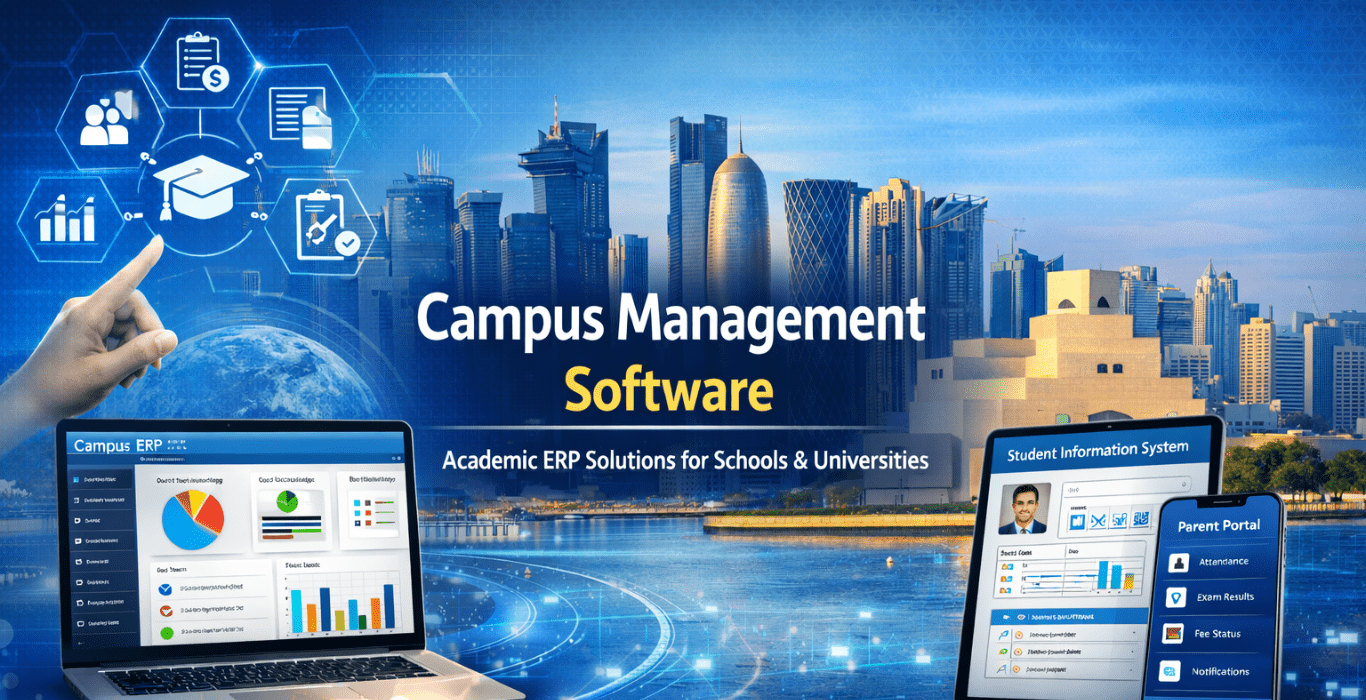
Campus Management Software for Oman Schools & Universities
Introduction
Digital campus management can be defined as the organized application of integrated academic technology to manage the operations of an institution. In contemporary learning environments, institutions need to have a centralized platform that integrates admissions, academics, finance, exams, and communications.
In the ever-changing education landscape in Oman, the role of Campus Management Software is pivotal in facilitating organized academic administration. Educational institutions are expected to be more transparent in their operations, comply with regulations, and offer timely information about the institution. Manual processes are not feasible in today’s scenario, which requires efficiency, accountability, and online reporting.
Modernization is not just an upgrade but a change in operations that allows for decision-making and tracking of academic progress. For school administrators and university leaders in Oman, the implementation of organized systems ensures a stable and sustainable future.
Challenges in Traditional Academic Administration
Challenges in Traditional Academic Administration
However, despite the robust academic frameworks, many institutions still experience inefficiencies because of manual processes and unconnected software tools.
MANUAL ATTENDANCE
The use of paper-based attendance registers and unconnected spreadsheets wastes administrative time and leads to late reporting. The lack of real-time monitoring prevents proactive measures for student underperformance.
FEE MANAGEMENT ERRORS
Manual processing of invoices and ledger accounts increases the chances of errors, account reconciliation, and incomplete financial reporting. Financial reporting becomes challenging without an automated Fee Management System.
EXAMINATION INEFFICIENCIES
Exam timetabling, marking, and result compilation involve coordination between various departments. Without organized Examination Management Software, errors and reporting delays can undermine academic integrity.
COMMUNICATION GAPS
Unconnected communication between faculty, administration, students, and parents creates information silos. The lack of an organized Parent Portal or Student Portal prevents proactive engagement.
The above issues highlight the need for digital transformation in the Bahrain academic community.
Strategic Role of Campus Management Systems
A Campus Management Software solution that is properly implemented will be the functional spine of a modern educational institution.
CENTRALIZED DATA
An integrated Student Information System (SIS) will ensure that student data, academic information, and financial details are maintained in one secure database. This will eliminate any duplication and improve consistency.
AUTOMATION:
Automation of workflows helps in the management of admissions, attendance, examination results, and fee payments. The administrative burden is decreased, and the efficiency of operations is increased.
TRANSPARENCY:
Access control based on roles helps in increasing accountability in various departments. The administrators, teachers, and parents can access authentic data, which is in line with the school’s policies.
REAL TIME REPORTING:
The integrated dashboards of the software enable analytical insights into academic performance, attendance, and financial data. Real-time reporting helps in strategic planning and managing compliance.
By following a structured approach to implementation, the Campus Management Software enhances the governance and discipline of the institution.
Key Modules
An Academic ERP Solution must have the following key modules:
- Student Information System (SIS) – This module helps manage student information, attendance, and academic records centrally.
- Attendance Management System – This module helps manage student attendance automatically, with the option of sending notifications.
- Fee & Finance Management System – This module helps generate fees, collect fees online, reconcile fees, and generate financial reports.
- Examination Management System – This module helps manage exams, grading, result analysis, and result reports.
- Parent & Student Portal – This module provides a secure online interface to view attendance, results, notifications, and communication services.
- All these modules work in perfect sync with Learning Management Systems, Admission Management Systems, and Education ERPs.
IMPLEMENTATION ISSUES
Implementation of the Campus ERP system needs strategic planning and technical analysis.
CLOUD-BASED BENEFITS
The Cloud-Based Campus ERP system has lower infrastructure costs and remote accessibility. Educational institutions in Bahrain benefit from automatic updates and system management.
DATA SECURITY
Data encryption, authentication mechanisms, and adherence to Bahraini regulations ensure confidentiality of student data and system security.
SCALABILITY FOR GROWING INSTITUTIONS
Scalable Higher Education ERP systems cater to growing enrollment, multi-campus models, and changing programs.
CONCLUSION:
For educational institutions in Oman, the implementation of structured Campus Management Software is a move towards operational excellence. This is because institutions will be able to improve their governance while enhancing the delivery of education.
A well-structured digital campus framework helps in the sustainability of institutions.